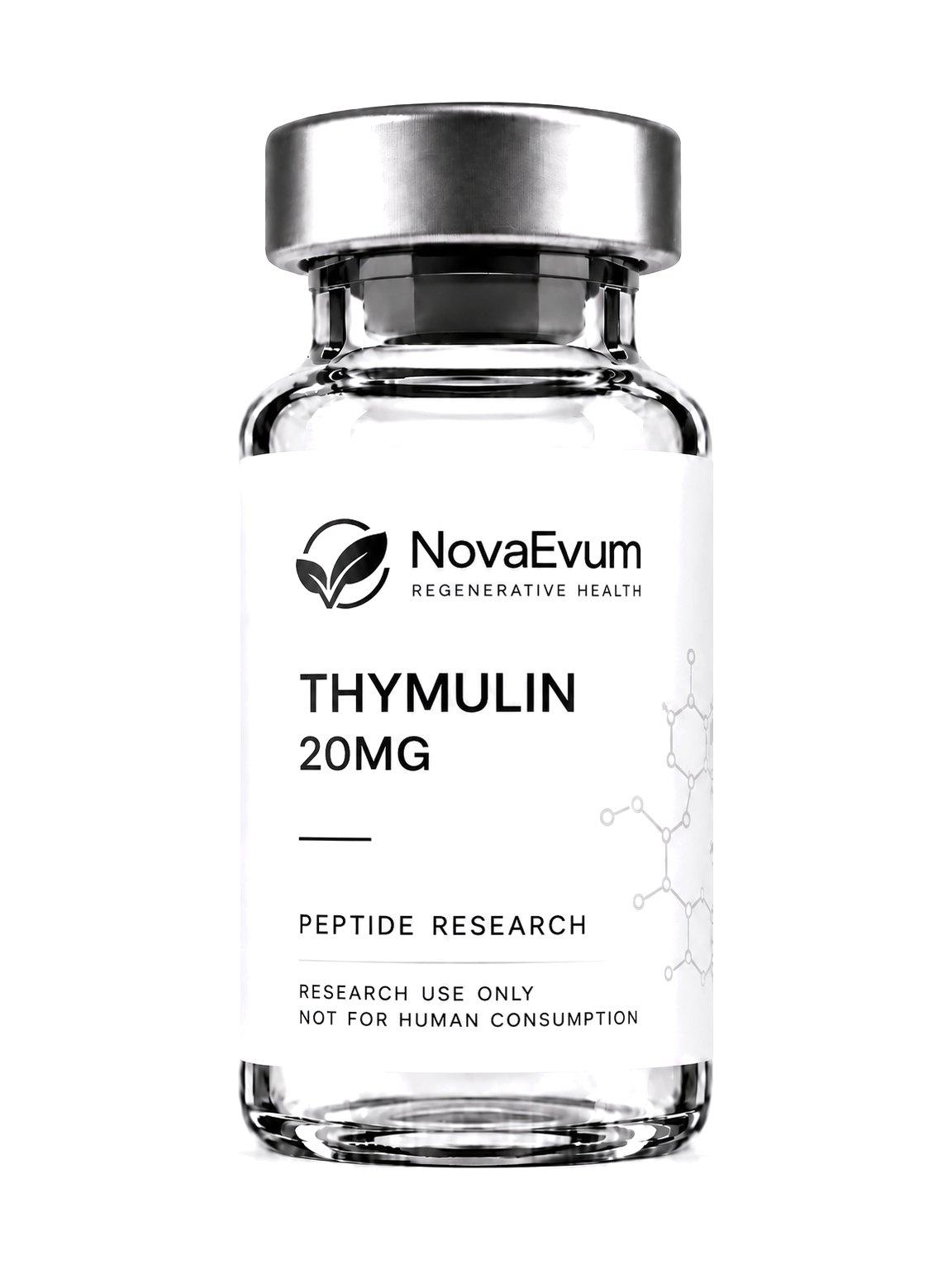
Thymulin (FTS) research peptide, Canada
Facteur thymique sérique · FTS · Nonathymulin · Thymalin · Shipped across Canada
Each vial contains 20 mg of Thymulin.
Thymulin is a zinc-dependent nonapeptide first isolated as facteur thymique sérique from calf thymus. What the literature examines, how far it got, and whether any regulator has approved it are set out under How it works below.
- Lyophilized powder, requires reconstitution
Price
$60.00 CAD
$3.00 / mg
In stock
- 24/7 customer support
- Lab tested purity & quality
- Free shipping on all orders




Thymulin in Canada
Ships from Toronto to anywhere in Canada, priced in Canadian dollars, payable by Interac e-Transfer or card.
Specification
- CAS number
- 63958-90-7
- Molecular formula
- C33H54N12O15
- Molecular weight
- 858.85 g/mol
- Sequence
- Pyr-AKSQGGSN
- Purity
- ≥ 99.79% by RP-HPLC
- Form
- Lyophilized powder
- Third-party assay
- Purity and fill
- Storage
- -20 °C, protected from light
How it works
The thymus makes it, and it was found in blood serum before anyone knew which cells produced it. What most of the literature tests is how the peptide behaves with and without the zinc ion it binds.
Zinc binding
The active form
Studies from the 1980s reported that the peptide binds one zinc ion and that activity in the assays of the time depended on it. Papers distinguish the zinc-bound form from the zinc-free nonapeptide for that reason.
T-cell differentiation
What the cell and animal work measured
Markers of T-cell maturation in cell culture and in thymectomised rodents, the setting in which the factor was first characterised.
NF-κB in myeloid cells
Ageing and inflammation, 2026
A 2026 mouse study (Kanemaru et al., Nature Communications) linked the age-related fall in circulating thymulin to inflammatory cytokine output by myeloid cells, through NF-κB signalling, and examined it alongside anti-PD-L1 in mouse breast-tumour models.
Neuroendocrine signalling
A later line of work
Rodent work on links between thymulin and the hypothalamic-pituitary axis, and on inflammatory signalling in models of pain and inflammation.
Where the evidence stands
Mostly preclinical, including the 2026 work, which was in mice. The few human studies are old and small. It is not approved as a medicine in Canada or the United States.
Laboratory results
Opened as the laboratory issued them, unedited. Every certificate we publish
Research use only
Supplied as a laboratory research chemical. Not a drug, food or cosmetic, and not for human or veterinary use. No application guidance is provided or implied.
What Thymulin is
Thymulin was first described as a factor in blood serum that the thymus produces, which is why its original name, facteur thymique sérique, means serum thymic factor. Its sequence was reported in 1977.
Most of its literature concerns the zinc-bound peptide and T-cell differentiation in cell culture and rodent models. A small number of older clinical studies measured immune-cell markers; they are few, small and not widely replicated.
| Property | Thymulin |
|---|---|
| Length | 9 amino acids |
| Sequence | pGlu-Ala-Lys-Ser-Gln-Gly-Gly-Ser-Asn |
| Metal | Zinc, one ion per peptide in the active form |
| Source in the body | Thymic epithelial cells |
| Other names | Facteur thymique sérique, FTS, nonathymulin |
Thymulin vs Thymalin vs Thymosin Alpha-1
Three thymic materials with similar names, often confused. The table sets out what each is; each has its own literature, and none transfers to the others.
| Name | What it is | Length |
|---|---|---|
| Thymulin | One defined peptide, zinc-dependent | 9 amino acids |
| Thymalin | Thymus extract, a peptide mixture | Mixed |
| Thymosin Alpha-1 | One defined peptide | 28 amino acids |
Thymulin research: a 2026 study of ageing and inflammation
Thymulin levels in blood fall with age, as the thymus shrinks. A 2026 study from the University of Southern California, published in Nature Communications, asked whether that decline is connected to the rise in inflammatory signalling seen in older animals.
The group found more pro-inflammatory myeloid cells, the immune cells that make cytokines such as IL-1, IL-6 and TNF-α, in aged mice and in samples from older people. Joining the circulation of old and young mice, and transplanting bone marrow between them, pointed to a factor in young blood rather than in the cells themselves, and their analysis identified thymulin as one such factor, acting through NF-κB signalling in those cells.
They then examined thymulin in mouse breast-tumour models, measuring T-cell responses and the response to an anti-PD-L1 antibody, in young and aged mice.
This is one study, in mice, with human samples used for comparison only. It has not been tested in people, and a finding in a mouse tumour model is a question for further research, not a property of the material sold here.
| Question | What the study used |
|---|---|
| Model | Young and aged mice; human blood samples for comparison |
| Cells examined | Myeloid cells and their cytokine output |
| Pathway | NF-κB signalling |
| Tumour work | Mouse breast-tumour models, with anti-PD-L1 |
| Stage | Preclinical |
References
- Kanemaru H et al., Nature Communications 2026: thymulin, age-associated myeloid inflammation and cancer immunotherapy. PMID 42481458
How this Thymulin is tested
Two questions matter about any vial of research peptide: is it the molecule on the label, and what else is in it. They are answered by different tests, and a certificate is only as useful as knowing which of the two it covers.
High-performance liquid chromatography (HPLC) answers the second. It separates the contents of a sample and reports how much of what it detects is the main component. That figure belongs to the lot that was tested, which is why it is stated on each certificate and not here.
Mass spectrometry answers the first. It measures the mass of the molecule, which for Thymulin should match a molecular weight of about 858.85. HPLC alone does not establish identity; a certificate that reports a mass result does.
Every certificate published for this compound is linked under Laboratory results above, with the laboratory, the test date and the vial size it covers. Read each for which tests it reports.
Buying Thymulin in Canada
NovaEvum ships Thymulin from Toronto to every province and territory, in a 20 mg size, priced in Canadian dollars.
Orders placed before 2:00 PM ET on a working day are dispatched the same day by tracked express parcel, which reaches most of Canada in one to two working days and remote areas a little later. In the Greater Toronto Area, larger orders placed before the cutoff can be couriered the same evening; the threshold is on our shipping page. Shipping is free on every order.
Pay by Interac e-Transfer, which takes 10% off the goods, or by card. Because the order ships from inside Canada, it never crosses a border: there is no customs declaration and no import hold.
Storage and laboratory handling
The specification for Thymulin is -20 °C, protected from light. Keep sealed vials frozen and away from light.
Lyophilised material tolerates ambient temperature in transit; put it back into cold storage on arrival. Let a cold vial reach room temperature before opening it, so moisture does not condense on the powder.
Thymulin FAQ
- What is Thymulin?
- A nine-amino-acid peptide, pGlu-Ala-Lys-Ser-Gln-Gly-Gly-Ser-Asn, first isolated from blood serum by Jean-François Bach’s group in Paris in the 1970s and named facteur thymique sérique (FTS). It is made by epithelial cells of the thymus.
- Is Thymulin the same as Thymalin?
- No. Thymulin is one defined nonapeptide. Thymalin is a thymus extract, a mixture of peptides, developed in Russia. The names are close and some sources mix them up, but a finding for one is not a finding for the other.
- Is Thymulin the same as Thymosin Alpha-1?
- No. Both are thymic peptides, but Thymosin Alpha-1 is a 28-residue peptide with a different sequence and its own, separate literature.
- Why is zinc mentioned with Thymulin?
- The peptide binds one zinc ion, and the published work reports that its biological activity in assays depends on that zinc. Papers often distinguish the zinc-bound form from the zinc-free peptide for that reason.
- Which Thymulin sizes are available?
- One size, 20 mg, as lyophilised powder. The size selector above shows the current price and stock for each.
- How is Thymulin shipped within Canada?
- From Toronto by tracked express parcel, dispatched the same working day for orders before 2:00 PM ET. Most of Canada receives it in one to two working days. Shipping is free on every order.
- How should Thymulin be stored?
- At -20 °C, protected from light, sealed and away from light. Return it to cold storage on arrival.
- Can I see a certificate of analysis before ordering?
- Yes. Every certificate published for this compound is linked under Laboratory results on this page, stating the laboratory, the date and the vial size it covers. For the certificate covering a specific lot, contact us before ordering.
- Is Thymulin for human use?
- No. It is supplied as a laboratory research chemical: not a drug, food or cosmetic, and not for human or veterinary use. No application guidance is provided or implied.